
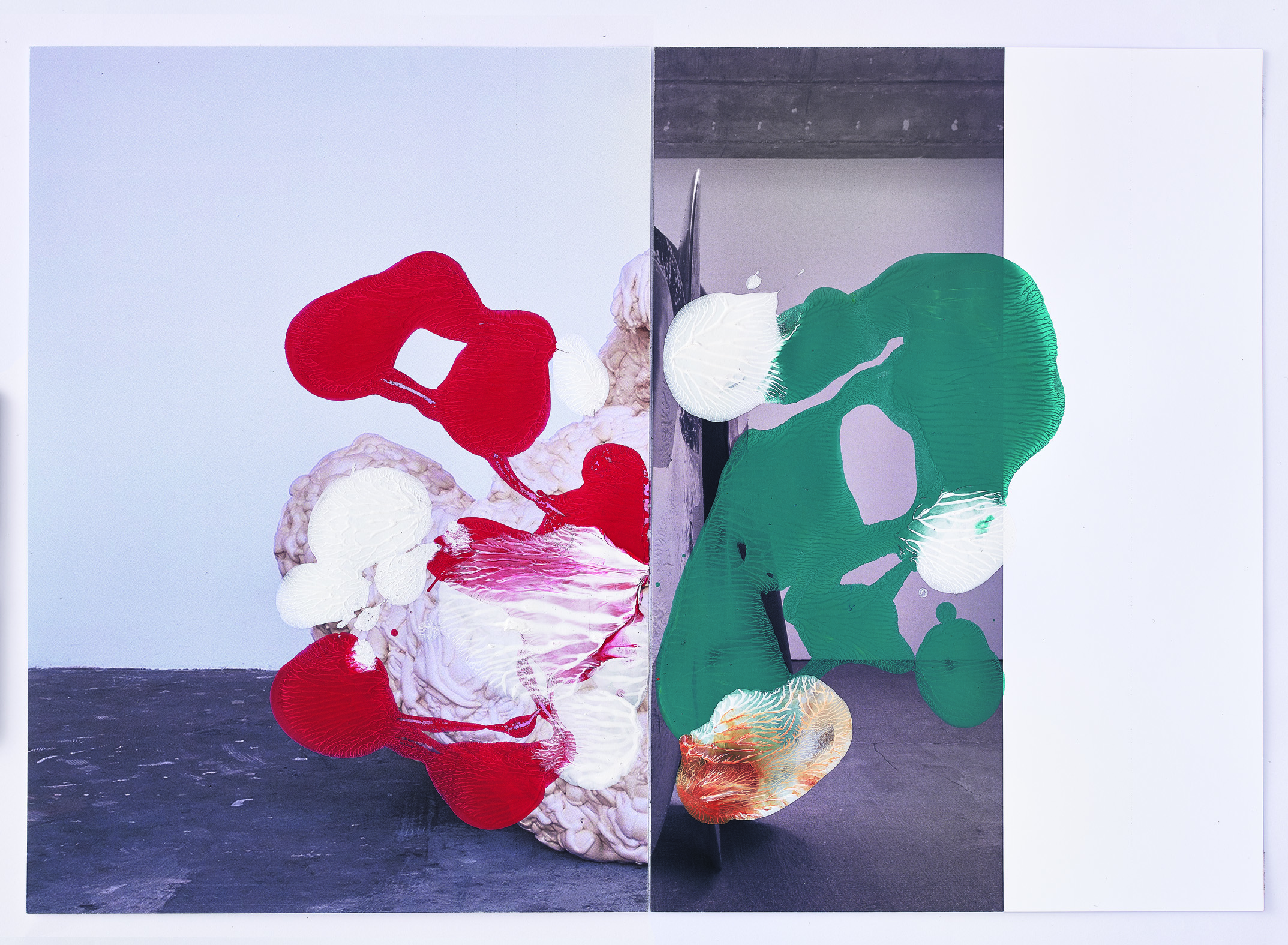
On Saturday, 8 August, at 8:30 p.m., the opening of About the Sense of Possibilities, an exhibition by artist Nikola Ukić, will take place at Apoteka – Space for Contemporary Art. The exhibition will remain on view until 13 September 2026.
Motivated by the need to emancipate sculpture from its participation in the violence of the colours of reason and blind matter, and deeply committed to the process of its redemption, the practice of sculpture as a historical field in the works by Nikola Ukić has by no means lost faith in emancipation, but he takes the need to set that faith on completely different ground all the more seriously.
This is what the Ducts speak about, another unusual, hybrid creature, of which we don’t know if it represents a living thing or a deadened being. It seems like one of the Tranformers we caught mid-transformation, partially already alive and fluid, and still clinging to the wall like an installation. Ducts starting from their title – Untitled (Ducts) – speak of the moment of liberation of/from form and function and establish an unusual tension between the categories of progress and growth, planned and spontaneous: installations as guarantors of universal urban development, civilisation and dignified life for all, become ‘untied’, free to realise their material existence according to a completely different principle.
Here, sculpture has become nature (with all the implications of that claim) in an ambivalent, potentially threatening expansion that we are unable to anticipate, let alone control. But here it is not about a moralistic ecological parable, but about the articulation of the need for new coordinates of life in a time that, in order to survive, requires more radical changes in the paradigm of looking at the world, beyond (Western) rationality.
With their idiom of incompleteness, decay and referential asceticism, do not seem melancholic, pessimistic or resigned. Their cruelty and weight certainly require us to face a certain loss of centre and foothold that deeply mark the experience of reality of the subjects of the 21st century, but at the same time they do not settle for nostalgia, but with their immediacy, sincerity and humour seem to be looking for creative power – as a central category of art and the community – precisely in this deficiency.
Vladimir Vidmar
(Excerpt from the catalogue essay, Make a Wish, MMSU Rijeka)
Nikola Ukić (Rijeka, 1974) lives and works in Düsseldorf, where he graduated from the Kunstakademie Düsseldorf after studying at the Academy of Fine Arts in Zagreb. At the core of his artistic practice is an ongoing exploration of processes of emergence and disappearance, growth and decay, through which he examines the fragile boundaries between nature and culture, and between life and matter. Grounded in an expanded understanding of sculpture, Ukić’s approach extends beyond the use of new materials and techniques to encompass a deeper engagement with space, the social environment, and the active participation of the viewer.
His working process is based not on mastery but on negotiation with the material. Rather than imposing form, the artist follows and guides the material as it develops, deliberately allowing room for unexpected outcomes shaped by primary, unconscious processes. This vitalist and ecocentric practice reflects deeply on the relationship between form and content, with form no longer functioning as a mere counterpart but instead becoming a kind of alter ego to content itself.
Avoiding direct expressions of day-to-day political positions, Ukić’s works neither impose fixed meanings nor advance ideological agendas. Instead, they treat form as an irreducible category, creating space for different states, tensions, and oppositions to coexist without seeking to reconcile or neutralize them. His poetics of form thus arise not from the illusion of harmony or the erasure of difference, but from the capacity to sustain that irreducibility.
Apoteka is supported by the Ministry of Culture and Media of the Republic of Croatia, the Kultura Nova Foundation, the City of Vodnjan, the Istria County, the TZ Vodnjan and Medea Wines.
back to artists